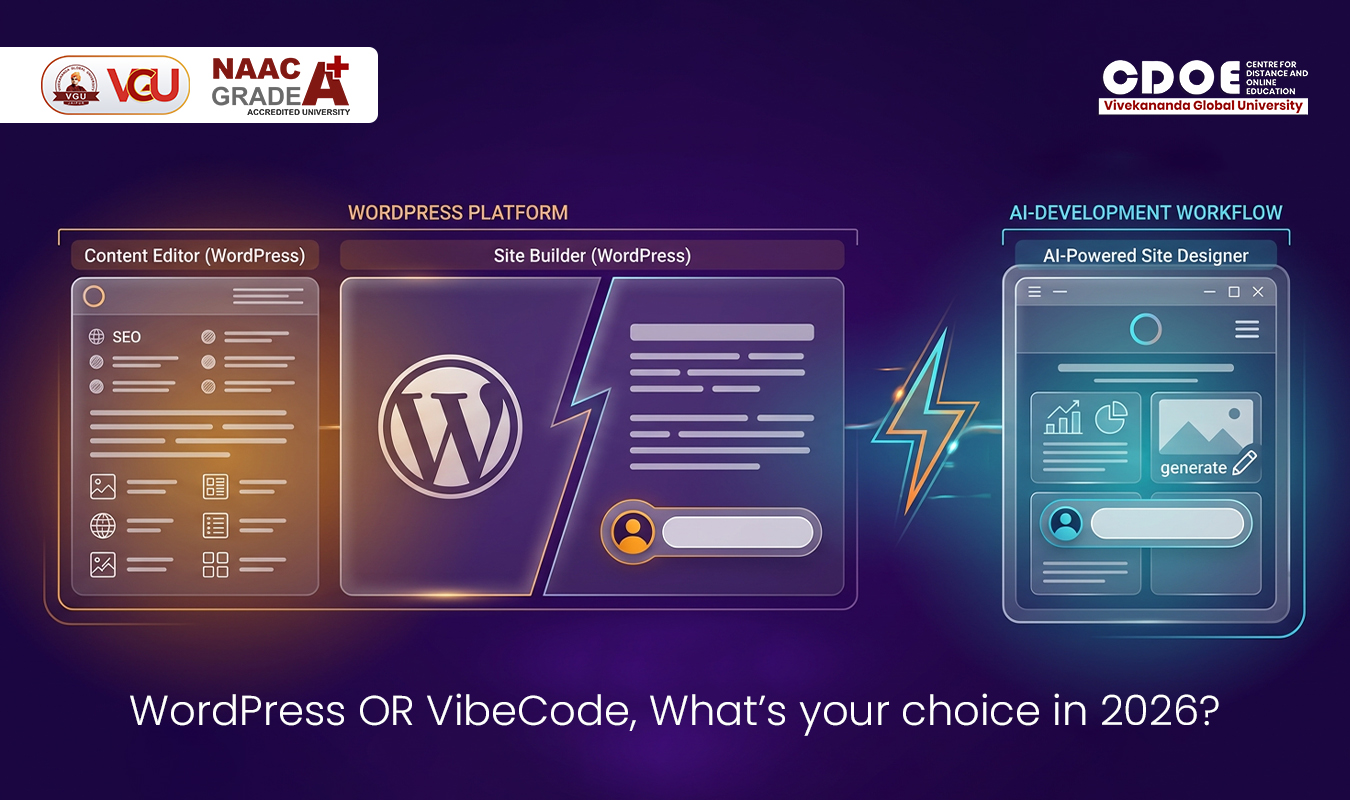
There is a common question from students and professionals about WordPress. Is WordPress Still Relevant in 2026? People are exploring AI tools that build websites from a simple text prompt. Naturally, they ask this question.
WordPress started in 2003. Its goal was simple. It wanted to make it easy for non-programmers to create beautiful, functional websites. It is open-source software. This means programmers can easily change its structure or create new designs and release it back to the community.
How it Works
The core WordPress handles the basics. This includes user accounts, creating pages, and writing posts. It also has a powerful block editor. But the real magic comes from the marketplace. You can add themes and plugins from WordPress marketplace to give your website new features. You can customize its appearance exactly how your organization needs using themes available in WordPress marketplace.
The marketplace has grown huge over time. At the time of writing this blog in December 2025, there are 60,000 free plugins available. There are also 14,000 free themes on WordPress.org. Today, you can build almost any type of website. Author of this blog has personally helped many individuals and organizations set up websites, online stores, blogs, school management systems, news portals, and landing pages.
The Power of the Ecosystem
WordPress is incredibly popular. In 2025, it powers 43% of all websites on the internet [1]. Because it is so popular, it is the first choice for big tech companies. For example, Facebook created an official plugin [2] to connect their marketing tools to WordPress. Why did they do this? They saw the demand. They created it for free for all WordPress users. If you hired a developer to build this connection from scratch, it would cost a lot of money. You would also have to pay for updates constantly.
With WordPress, big companies like Google [3] and Microsoft [4] provide these tools for free. Everyone wants their software to work with WordPress. This ecosystem moves fast. When ChatGPT launched in November 2022, developers reacted immediately. They built plugins to connect ChatGPT to WordPress right away [5]. WordPress is not just software; it is a community. If a new technology arrives, WordPress developers build solutions for it instantly.
AI Builders vs. WordPress
Now, let’s talk about AI website builders. Yes, they are good. They create professional results with just a few prompts. However, a website is more than just pretty pages.
Organizations need a website to grow their business. It needs to work with marketing tools. It needs good SEO features. As a business grows, the website needs to grow too.
Websites built purely by AI often lack this flexibility. They are hard to extend. You often need a developer to write new prompts or fix the code. If you need a specific update, it can be difficult to change the structure of an AI-generated site.
WordPress Grows with AI
On the other hand,
- WordPress developers are adding AI into their plugins.
- SEO plugins now use AI to help you rank better.
- Content plugins use AI to help you write faster.
- WordPress plugins are available to create chatbot using AI APIs.
This is a better approach. An authorized team member from your organization can use a specific AI tool to do their job without breaking the rest of the website. For example, content manager will work only on writing and improving content and marketing person will work only on SEO and related aspect of website.
Conclusion
In short, WordPress is growing with AI. It is becoming even more useful. Using AI without a framework like WordPress makes it hard to add features later. It also makes it complex to keep your site secure and updated.
If you are reading this in December 2025 or later, WordPress is a must-learn skill. It is essential whether you are building a website for yourself or for clients.
Because it is so useful, we at CDOE, VGU have decided to launch a short course on WordPress. It is available for our existing students for free.
[1] https://w3techs.com/technologies/details/cm-wordpress
[2] https://wordpress.org/plugins/facebook-for-woocommerce/
[3] https://wordpress.org/plugins/google-site-kit/
[4] https://wordpress.org/plugins/microsoft-clarity/
[5] https://community.openai.com/t/i-made-a-wordpress-plugin/23358
About Author:
Dr. Yogendra Pal is a computer scientist and educator with deep expertise in both core software development and Content Management Systems. B.Tech. and M.Tech in computer science and Engineering Dr. Pal holds a Ph.D. in Educational Technology from IIT Bombay. He served as a Project Research Scientist where he developed and maintained the frontend of IIT Bombay's MOOC platform and worked on the National Virtual Library of India using Drupal. His technical background includes system-level programming at CDAC, where he worked on kernel modifications for the NetBSD operating system as a Project Engineer. Bridging the gap between complex coding and accessible web building, he has produced extensive video tutorial series on Web Development, HTML, and creating E-commerce websites using tools like WordPress and Drupal.